
Rule of thumb: if the room above or next to your garage never holds temperature no matter what the thermostat says, the garage door is probably leaking air — but only if the leak is actually at the door, not somewhere else in the garage. That exception matters, because plenty of attached-garage heat loss has nothing to do with the door itself, and chasing the wrong culprit is how these arguments drag on for three winters in a row.
Here's the honest version of the explanation, so whoever loses this argument at least understands why.
Why the garage door matters more than people think
An attached garage isn't a separate building — it shares at least one wall, and often a ceiling, with living space. If that garage is 15–20 degrees colder than the house because the door is leaking outside air, that cold is pulling heat out of the adjacent rooms right through the shared wall. Pipes, ductwork, and sometimes the laundry room sit right on the other side of that wall. A leaky door doesn't just make the garage uncomfortable; it turns the garage into an extension of outdoors that's directly attached to your heating and cooling system's biggest surface area.
In summer the same thing happens in reverse — humid outside air leaks in, the garage gets muggy, and the AC in the house works harder to offset the heat and moisture bleeding through that shared wall.
The signs you can actually check tonight
- Daylight visible along the bottom or sides of the closed door
- A cold draft you can feel standing a foot back from the door, not just touching it
- Frost or ice forming on the inside of the door panels in deep cold
- Condensation dripping off the bottom panel onto the floor
- Weatherstripping that's cracked, flattened, or pulling away from the frame
- The door visibly flexing or rattling when wind hits it during a storm
If you see two or more of these, the door is almost certainly part of the problem.
Why this shows up so often in older houses around here
A lot of homes in this part of New Hampshire still have their original garage door — sometimes decades old, often a single-layer steel panel with no thermal break and minimal factory weatherstripping. Add in freeze-thaw cycles all winter, road salt spray, and the occasional nor'easter pushing wind-driven snow straight at the seams, and the rubber seals on an old door degrade faster than people expect. Cold contracts rubber and makes it brittle; repeated freezing and thawing cracks it further. By the tenth winter, the bottom seal that used to press flat against the slab is curled, torn, or missing chunks entirely, and nobody notices until the heating bill creeps up.
What's often blamed unfairly
Before you pin the whole bill on the door, rule out a few other usual suspects, because fixing seals won't help if these are the real issue:
- Attic insulation above the garage ceiling — if it's thin or compressed, heat escapes upward regardless of the door
- An uninsulated door between the garage and the house — if that interior door is hollow-core with no weatherstripping, it leaks on its own
- Ductwork or registers routed through the garage ceiling — leaky duct joints lose conditioned air whether the garage door is sealed or not
- A thermostat location issue — a thermostat near a drafty hallway can misread the whole house's temperature
If any of those apply, the garage door is still worth fixing, but it isn't the whole story.
The two-minute test that settles it
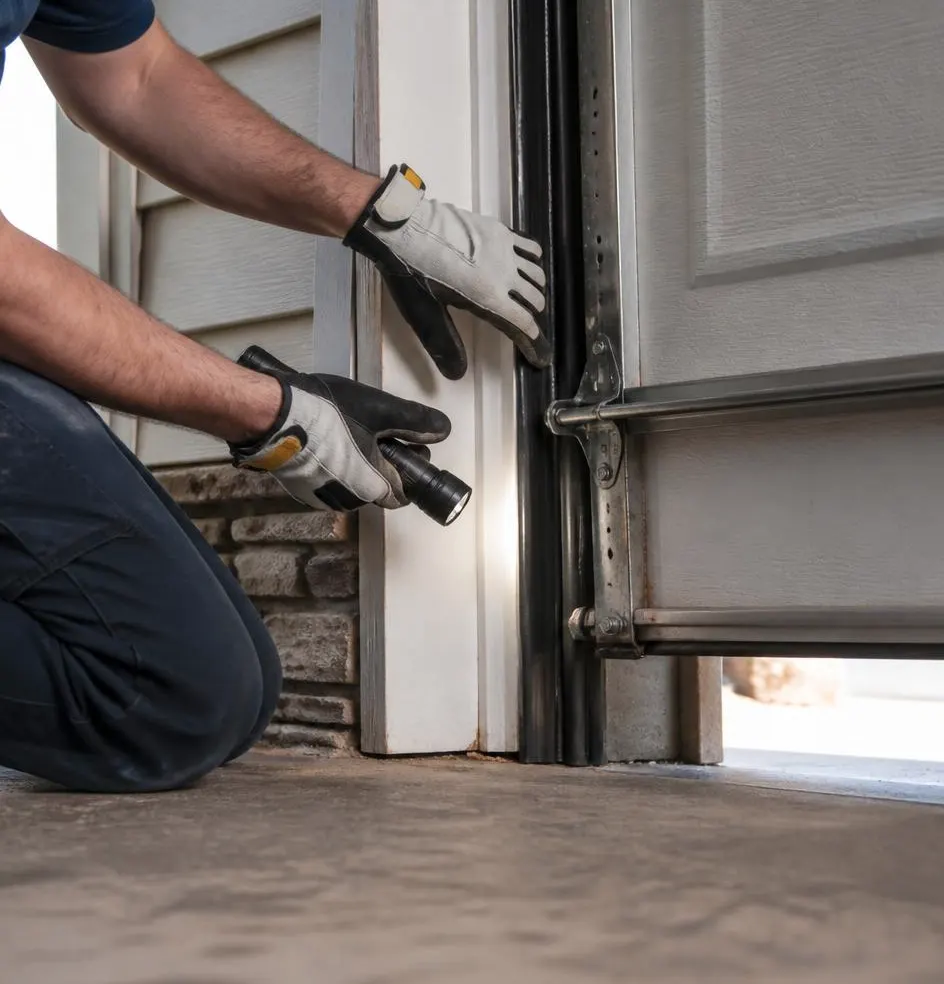
Close the garage door at night and run a flashlight along the bottom and side gaps from inside — any light leaking through means air is leaking through too. For the bottom seal specifically, slide a dollar bill under the door before closing it; if you can pull it out with no resistance, the seal isn't making contact with the floor. Do this on a few different nights, especially during a cold snap or right after a storm, since wind pressure changes how obvious the draft is.
Fixing it, from cheapest to most involved
- Replace side and top weatherstripping — inexpensive, often a DIY job, but needs the right track size for your door model
- Replace the bottom astragal seal — slightly more involved since it has to seat correctly against an often uneven garage floor
- Add rigid foam insulation panels to the door itself — helps with temperature swings but won't fix air leaks around the edges on its own
- Full door replacement with an insulated, dual-layer panel — the most effective fix for an old single-layer steel door, with pricing that varies widely by size and material, so get it quoted rather than guessed at
Weatherstripping and seals solve most of the draft problem. A full insulated door solves the draft problem and the temperature-swing problem, which matters more if the garage sits under a bedroom or next to a frequently used room.
When to call Kingston Garage Door
If the flashlight and dollar-bill tests point to the door, that's exactly what a seasonal Garage Door Maintenance visit is built to catch — checking seals, hardware, and balance before winter locks everything in place with ice. If the weatherstripping is already cracked, torn, or missing sections, that's a straightforward Garage Door Repair call rather than a reason to replace the whole unit. Either way, it's worth handling before the next deep freeze or nor'easter turns a small gap into a bigger problem.
If you're in Kingston, Plaistow, Newton, East Kingston, Danville, Hampstead, Sandown, or Brentwood and want someone to look at the seals before the cold really sets in, call Kingston Garage Door — we'll tell you straight whether it's the door, the seals, or something else entirely.